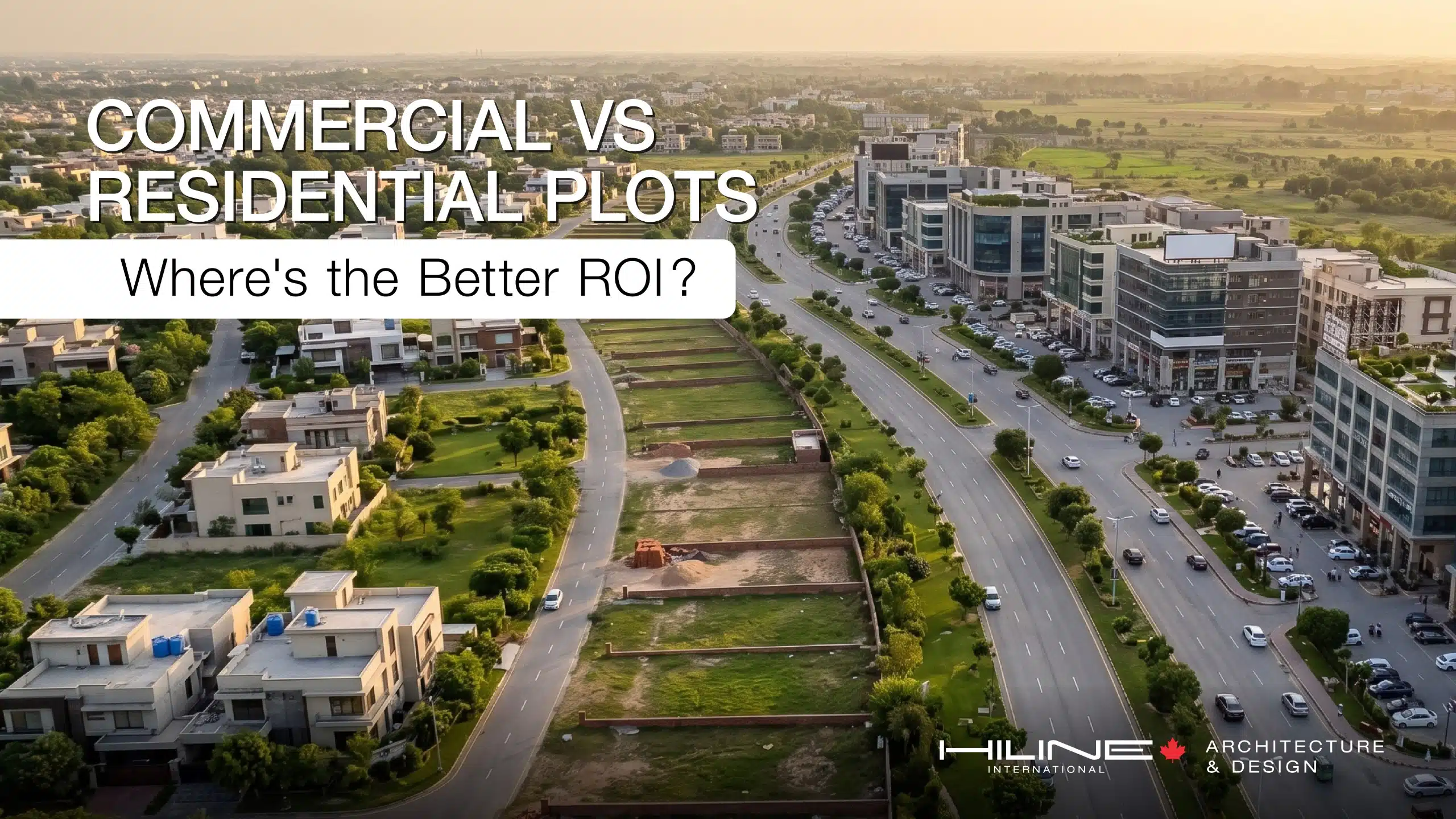
Investing in real estate is a major financial decision, especially when choosing between commercial and residential plots. Both options can offer long-term value, but they serve different purposes and come with different costs, risks and income opportunities.
A commercial plot may appeal to investors planning to develop shops, offices or other permitted business premises. A residential plot may be more suitable for someone planning to build a family home or hold land for future appreciation. The right choice depends on the location, purchase price, investment timeline and the investor’s financial goals.
However, one important distinction often gets overlooked: a vacant plot does not normally generate rental income. To earn conventional rent, an investor generally needs to develop a rentable property or purchase an existing income-producing asset.
In this guide, we compare commercial and residential plots, explain how investment returns work, and explore the factors that can help you make a more informed property decision in Lahore and other parts of Pakistan.
What Is the Difference Between Commercial and Residential Plots?
Before comparing returns, it is important to understand how these two types of land differ.
What Is a Commercial Plot?
A commercial plot is designated for permitted business-related activities. Depending on its approved use and applicable regulations, it may be developed into shops, offices, showrooms, restaurants or other commercial premises.
Commercial property can attract investors because businesses may be willing to pay rent for locations that offer good visibility, customer access, parking and proximity to other businesses.
However, a commercial designation does not guarantee profitability. Demand depends on the location, surrounding activity, property type and whether businesses can operate successfully there.
What Is a Residential Plot?
A residential plot is intended for permitted residential use. Buyers may purchase one to construct a house, build a property for future use or hold the land as a long-term investment.
Residential plots can appeal to people who want greater control over the design and timing of their future home. Investors may also benefit from appreciation if demand increases and the property becomes more valuable.
Nevertheless, vacant residential land generally produces no rental income while it remains undeveloped. Its investment performance depends primarily on changes in market value and the costs associated with holding and eventually selling it.
Why Land Use Matters Before Buying
Not every plot can legally be used for every purpose. Before purchasing land, verify ownership documents, approved land use, possession status, development progress and applicable building regulations.
In Lahore, the relevant development authority or housing scheme may determine what can be constructed and whether additional approvals are required. The Lahore Development Authority provides access to regulations and building-plan information that buyers can use as part of their due diligence.
Commercial vs Residential Plots: Quick Comparison
The following table summarises the main differences investors should consider.
| Factor | Commercial Plot | Residential Plot |
| Primary purpose | Permitted business-related development | Permitted residential development |
| Income potential | Rental income after suitable development | Rental income after suitable development |
| Capital requirements | Can be substantial in established commercial locations | Varies by location, plot size and development |
| Demand drivers | Business activity, visibility, access and customer demand | Housing demand, accessibility and neighbourhood facilities |
| Development costs | Depend on building type, structure and permitted use | Depend on house design, covered area and specifications |
| Vacancy risk | Depends on tenant demand and business conditions | Depends on property type, location and tenant demand |
| Appreciation | Influenced by commercial activity and location | Influenced by housing demand and location |
| Main consideration | Commercial feasibility and tenant demand | Residential suitability and future demand |
Neither category guarantees better returns. A well-priced residential plot in a location with genuine demand may outperform an overpriced commercial plot in an underdeveloped business area.
The most useful comparison is therefore not simply commercial versus residential. It is the total investment required, the expected income or appreciation, and the risks involved.
Commercial Plots: Benefits, Income Potential and Risks
Commercial plots can offer attractive opportunities, particularly when they are located in established business areas. However, their performance depends on much more than the plot’s purchase price.
Potential for Rental Income
A commercial plot may be developed into a building containing shops, offices or other permitted rental spaces. Depending on the design and tenant demand, a completed building may generate income from one or multiple tenants.
For example, a small commercial building with several occupied shops may produce rental income from different businesses. However, the investor must account for construction expenses, maintenance, vacancies, taxes and other ownership costs before determining whether the investment is profitable.
The location is especially important. Businesses typically evaluate customer access, visibility, parking, nearby competition and the spending activity of the surrounding population before committing to a rental property.
Location and Business Demand
A commercial plot in an established market may have a different investment profile from one in a newly developing area.
Before purchasing, assess whether businesses are already operating nearby, whether the area attracts customers and whether the proposed property suits the type of tenants you want to attract.
A plot may appear inexpensive because its surrounding commercial activity has not developed as expected. If businesses are unwilling to rent there, the owner may face long vacancy periods or difficulty recovering the investment.
Higher Capital Requirements and Development Risks
Commercial development can require substantial capital, depending on the location, building specifications and intended use.
Expenses may include the plot price, professional design fees, approvals, construction, utilities, finishing and tenant-related fit-out. An investor must also have enough financial flexibility to manage unexpected expenses or periods without rental income.
Who should consider commercial plots?
Commercial land may suit investors who understand the local business market, can evaluate the feasibility of the intended development and have sufficient capital to manage construction and vacancy risks.
Residential Plots: Benefits, Appreciation and Risks
Residential plots are often considered by buyers who want to build a home, hold land for future use or invest in locations with long-term housing demand.
Long-Term Residential Demand
Housing demand is influenced by factors such as employment opportunities, accessibility, neighbourhood development, schools, healthcare and other essential services.
A residential plot in a suitable location may become more valuable as the surrounding area develops. However, appreciation is never guaranteed, and prices can stagnate or decline depending on market conditions.
Investors should evaluate the actual demand for properties in the specific area rather than assuming that every housing society or developing location will appreciate at the same rate.
Flexibility for Future Use
One advantage of residential land is the option to plan a house according to personal requirements, subject to applicable regulations.
A buyer may purchase a plot now and construct a home later when the budget and family circumstances allow. This can be useful for people who want to plan their future housing without immediately committing to a complete construction project.
Before purchasing, however, confirm the plot’s dimensions, development status, utility availability and permitted construction requirements. These factors will influence what can realistically be built.
Capital Appreciation and Holding Costs
An undeveloped residential plot may appreciate in value, but it usually does not provide conventional rental income while vacant.
The owner may still incur holding costs, applicable taxes, maintenance or security expenses and eventual selling costs. If the property takes longer than expected to appreciate or sell, these expenses can reduce the overall return.
Who should consider residential plots?
Residential plots may be suitable for buyers planning a future home or investors who prefer to focus on land appreciation and can afford to hold the property over an appropriate period.
Rental Income vs Capital Appreciation: Which Matters More?
The answer depends on whether your priority is regular income, an increase in property value or a combination of both.
Understanding Rental Yield
Rental yield measures the annual rental income generated by a property relative to its purchase price.
The formula for gross rental yield is:
Gross rental yield = (Annual rent ÷ Property purchase price) × 100
Consider a hypothetical example. An investor purchases a completed commercial property for PKR 20 million and receives PKR 1.6 million in annual rent.
The gross rental yield would be:
PKR 1.6 million ÷ PKR 20 million × 100 = 8%
This is only a gross yield. It does not account for maintenance, taxes, management fees, vacancies or other ownership expenses.
Net rental yield provides a more realistic picture by accounting for relevant expenses. For a fair comparison, investors should use a consistent cost basis and include acquisition expenses where appropriate.
Understanding Capital Appreciation
Capital appreciation is the increase in a property’s market value over time.
For example, suppose a plot is purchased for PKR 10 million and later sold for PKR 12 million. The difference is PKR 2 million before transaction costs, applicable taxes and other expenses.
This is a nominal increase in value, not necessarily the final profit. The investor must consider all acquisition and selling costs, as well as the time the property was held.
Inflation also matters. An increase in the property’s rupee value does not automatically mean the investment has gained the same amount in purchasing power.
Calculate Total Return, Not Just Rent
For a developed rental property, total return may include net rental income and any change in market value. For a vacant plot, the return usually depends on appreciation or a separate lawful income-generating arrangement.
A useful assessment should include:
- Purchase price and acquisition costs.
- Construction and development expenses, where applicable.
- Actual or realistically estimated rental income.
- Vacancy periods and operating expenses.
- Changes in market value.
- Selling expenses and applicable taxes.
- The total period of investment.
This approach provides a better basis for comparison than relying on advertised yields or expected appreciation alone.
Commercial vs Residential Plots: Which Requires More Investment?
The amount of capital required depends on the specific property and the investor’s plans. It is not accurate to assume that every commercial plot costs more than every residential plot.
Purchase Price and Initial Capital
Commercial land in established business locations can command high prices because of its permitted use and potential for business activity. However, prices vary widely across cities, neighbourhoods, plot sizes and development stages.
Residential plots also vary considerably in price. An established residential location may cost more than a commercial plot in a less active area.
Compare similar properties using current market evidence. Consider location, plot dimensions, possession status, documentation and access to services rather than comparing prices based on property category alone.
Construction and Development Expenses
The intended building type can significantly influence the total investment.
A commercial project may require a structure and layout suited to its approved use, tenant requirements and applicable regulations. A residential project may require a different combination of structural work, rooms, utilities, finishes and other facilities.
For both types, professional fees, construction quality, site conditions and project scope affect the budget.
HILINE’s architectural and interior design services can be relevant when assessing design requirements and planning a building around its intended use.
Additional and Ongoing Expenses
Property investors should also budget for expenses beyond the purchase price and main construction work.
Depending on the property and project, these may include:
- Applicable taxes, duties and registration expenses.
- Transfer charges and other transaction costs.
- Professional and approval fees.
- Utility connections and site preparation.
- Maintenance, repairs and property management.
- Vacancy allowances for rental properties.
- Selling costs when exiting the investment.
Current tax and valuation requirements should be checked against official sources, including the Federal Board of Revenue, rather than relying on outdated online estimates.
What Makes a Plot a Good Investment in Lahore?
The quality of the individual property is often more important than whether it is labelled commercial or residential.
Location and Accessibility
Evaluate access roads, connectivity, nearby development and the distance to relevant destinations. For commercial property, also consider customer access, visibility and business activity. For residential land, examine access to everyday facilities and the suitability of the neighbourhood for the intended occupants.
Real Demand
Look for evidence that buyers, residents or businesses genuinely want properties in the area.
For commercial plots, this may involve studying operating businesses, comparable rents, tenant demand and the performance of similar properties. For residential plots, examine comparable sales, occupancy, construction activity and demand for homes.
Avoid relying solely on promises of future development or guaranteed returns.
Legal and Planning Status
Verify ownership, title, possession, relevant approvals and permitted land use before committing funds.
In Lahore, check the applicable authority and the property’s status through official channels. A location’s popularity does not replace the need for legal and planning due diligence.
Development Feasibility
A plot should be assessed in terms of what can legally and practically be built on it.
Plot dimensions, access, applicable setbacks, covered-area limits, utilities and other regulations can affect the design and financial feasibility of the project.
For investors considering construction, reviewing these factors before purchasing can help prevent expensive surprises later.
Which Plot Is Better for Different Investor Goals?
Different investment objectives require different approaches.
For monthly income: Compare completed, rentable properties and their realistic net yields. Buying a vacant plot alone will not normally provide conventional rental income.
For long-term appreciation: Focus on the purchase price, local demand, development progress, holding costs and realistic resale prospects. Do not assume that either property category will appreciate automatically.
For future home construction: A residential plot may be more suitable if it meets your family’s needs, budget and intended construction timeline.
For commercial development: Consider commercial land when there is evidence of business demand and the proposed development is permitted and financially feasible.
For investors with limited capital: Compare the total cost of acquisition and ownership. Keep sufficient funds available for relevant expenses instead of committing the entire budget to the purchase price.
For investors who want less management responsibility: Consider how much involvement each option requires. A developed rental property may need tenant management and maintenance, while vacant land may require security, holding expenses and patience while waiting for appreciation.
The best investment is the one that matches your financial objectives, time horizon and ability to manage risk.
Common Mistakes to Avoid Before Investing in a Plot
Even a promising property can deliver disappointing results if important details are overlooked.
- Buying based on promised appreciation: Future price increases are uncertain and should not be treated as guaranteed.
- Assuming a commercial plot will attract tenants: Rental demand depends on the location, permitted use, property design and business activity.
- Ignoring development expenses: Construction and approval costs can materially change the investment’s financial outcome.
- Confusing gross yield with net yield: Operating costs, vacancies and applicable taxes reduce the income an investor actually keeps.
- Skipping legal verification: Ownership, possession, approved land use and relevant permissions should be checked before purchase.
- Underestimating holding costs: An investment may take longer than expected to appreciate or sell.
- Comparing non-equivalent properties: A developed shop and a vacant residential plot should not be compared as if both generate income in the same way.
A disciplined evaluation process helps investors avoid decisions driven by marketing claims rather than financial evidence.
Frequently Asked Questions
Are commercial plots more profitable than residential plots?
Not always. A well-located commercial property may offer attractive rental income after development, but it can also involve higher costs, vacancy risks and greater dependence on business demand. Residential plots may be more suitable for future home construction or land appreciation. Compare the specific properties and their expected total returns before deciding.
Do vacant plots generate rental income?
Vacant plots generally do not generate conventional building rent. Their investment return normally depends on appreciation or the proceeds from a future sale, unless a separate lawful income-generating arrangement exists. Rental yield calculations are more directly applicable to completed properties that generate rent.
Which is better for long-term investment in Lahore?
There is no universal answer. The decision depends on the property’s purchase price, location, demand, legal status, development prospects, holding costs and the investor’s financial objectives. Evaluate specific properties instead of relying on broad claims about commercial or residential land.
How do I calculate the return on a plot investment?
Start with the total acquisition cost, including relevant transaction expenses. For a developed rental property, calculate annual rental income and deduct operating expenses to estimate net yield. For land held for appreciation, compare the eventual sale proceeds with the total investment cost. Include development and selling expenses where applicable.
What should I check before buying a commercial plot?
Verify ownership, approved commercial use, possession, development status, access, utilities and applicable construction regulations. Evaluate nearby business activity, realistic rental demand and the feasibility of the intended development. Seek qualified professional advice where needed.
Is a residential plot a good option if I plan to build a house later?
It may be suitable if the location, dimensions, documentation and applicable regulations support your plans. Consider your future housing requirements, likely construction budget, utility availability and the costs of holding the plot until you are ready to build.
Make a Property Decision Based on Your Investment Goals
Commercial and residential plots can both play a role in a real-estate investment strategy, but they serve different purposes. Commercial land may be suitable for investors planning a business-related development in a location with genuine demand, while residential land may be more appropriate for future home construction or long-term ownership.
Before making a decision, compare the complete investment cost, legal and planning status, development feasibility and realistic return expectations. If construction is part of your plan, thoughtful architectural design can help align the building with the property’s intended use and physical constraints.
HILINE International brings architectural planning, interior design and construction knowledge together to help property owners explore practical development options. A clear understanding of your property and long-term goals is the best starting point for making an informed decision.