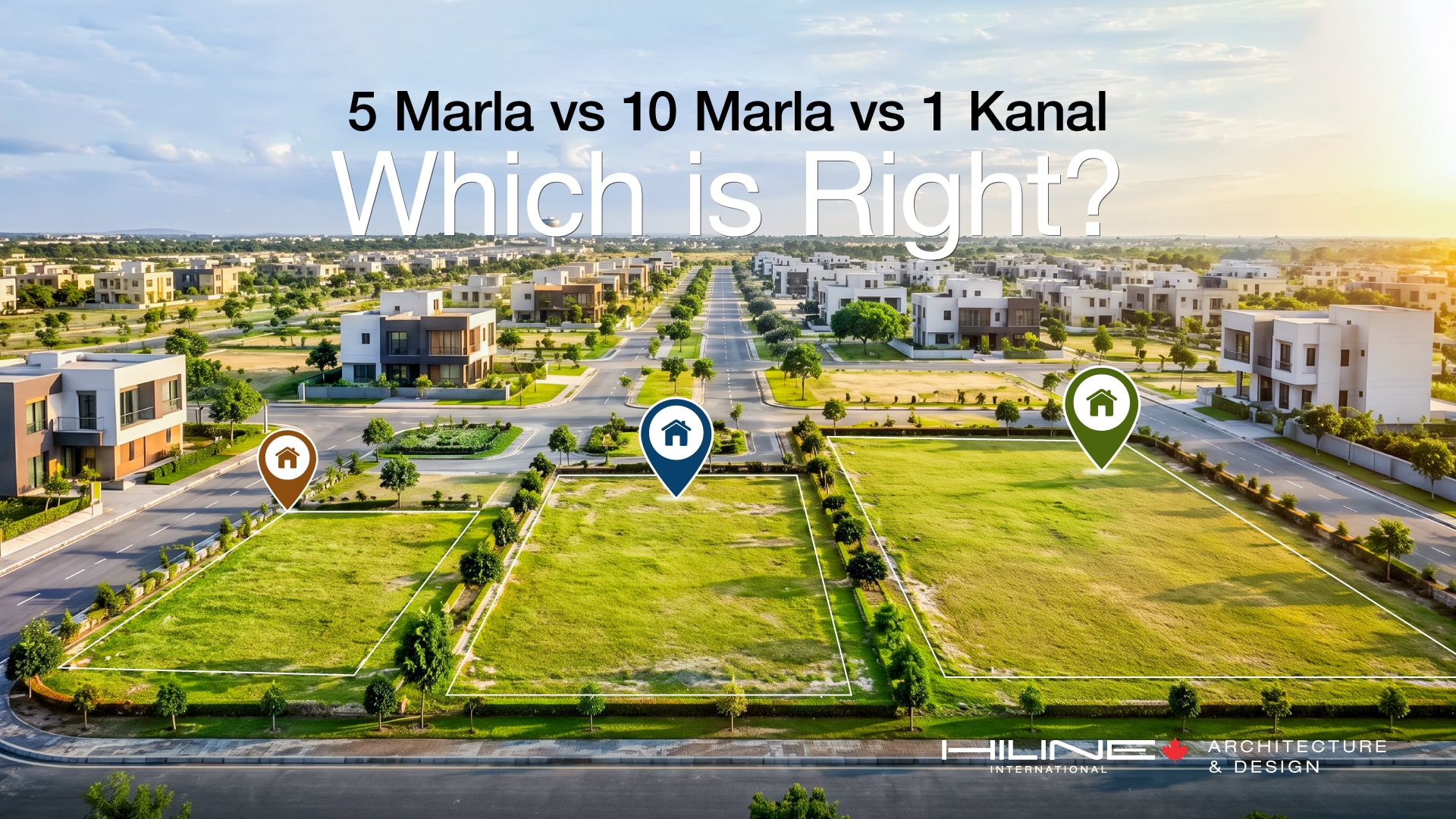
Choosing the right plot size is one of the most important decisions when planning a home in Pakistan. For many buyers, the choice often comes down to 5 Marla, 10 Marla, or 1 Kanal. While the larger options provide more space, the right choice is not simply about buying the biggest plot you can afford.
Your family size, lifestyle, parking requirements, desired number of bedrooms, outdoor space, construction budget, maintenance expectations, and long-term plans all influence which plot size may work for you.
A well-planned 5 Marla home can provide everything a smaller family needs, while a 10 Marla plot can offer more flexibility for growing families. A 1 Kanal plot can provide even greater opportunities for larger homes, gardens, guest spaces, and customized architectural planning.
The key is to understand how each plot size affects the way a home can be designed and used.
Key Takeaways
- 5 Marla, 10 Marla, and 1 Kanal offer different levels of planning flexibility.
- A larger plot is not automatically a better choice for every homeowner.
- Plot dimensions, frontage, depth, orientation, and local regulations matter alongside total area.
- 5 Marla homes generally require more efficient space planning.
- 10 Marla provides additional flexibility for bedrooms, parking, living areas, and outdoor spaces.
- 1 Kanal allows more expansive planning, but it can also involve greater construction and maintenance requirements.
- Good architectural planning can make a significant difference regardless of plot size.
- The right plot should support your current lifestyle as well as your realistic future requirements.
What Do 5 Marla, 10 Marla and 1 Kanal Mean?
Marla and Kanal are commonly used land-area units in Pakistan, particularly when discussing residential plots. However, the exact area represented by a Marla can vary depending on the local convention, housing scheme, or authority.
For this reason, buyers should always verify the actual plot dimensions and documented area with the relevant housing society or development authority instead of relying only on the plot-size label.
This is important because two plots with a similar stated area can have different dimensions. One may have a wider frontage while another may be deeper. These differences can affect parking, room layouts, natural light, ventilation, circulation, and outdoor space.
Why Plot Dimensions Matter
Total land area is only one part of residential planning.
An architect also needs to consider:
- Plot frontage and depth
- Road orientation
- Entry and parking requirements
- Setbacks and building regulations
- Position of neighboring properties
- Natural light and ventilation
- Privacy
- Staircase and circulation
- Outdoor areas
- Future expansion
Therefore, when comparing 5 Marla, 10 Marla, and 1 Kanal, it is useful to think about both how much land you have and how that land can actually be used.
5 Marla vs 10 Marla vs 1 Kanal at a Glance
| Factor | 5 Marla | 10 Marla | 1 Kanal |
| Overall planning space | Compact | Moderate | Generous |
| Planning flexibility | Requires efficient planning | Greater flexibility | Extensive flexibility |
| Outdoor space | More limited | More opportunities | Greater possibilities |
| Parking | Requires careful allocation | More flexible | More planning options |
| Room planning | Space-efficient | More generous | Highly flexible |
| Privacy planning | Depends strongly on layout | More options | Greater separation possibilities |
| Maintenance | Generally easier to manage | Moderate | Potentially more demanding |
| Suitable approach | Efficient and practical | Balanced and flexible | Spacious and customized |
These are planning considerations rather than fixed rules. Actual possibilities depend on the plot dimensions, local regulations, building requirements, budget, and the homeowner’s priorities.
5 Marla Plot: What Can You Plan?
A 5 Marla plot can be a practical option for homeowners who want a manageable residential property without requiring a large amount of land.
The main consideration is efficient space planning.
On a smaller plot, every part of the house needs to perform a clear function. Poorly positioned stairs, oversized circulation areas, or unnecessary spaces can reduce the usable area available for bedrooms, living spaces, storage, and parking.
Efficient Space Planning
A well-planned 5 Marla home may focus on:
- Functional room proportions
- Efficient circulation
- Practical storage
- Carefully planned parking
- Natural light
- Cross ventilation
- Vertical use of space
- Clear separation between public and private areas
Rather than trying to fit every possible feature into the house, the design should prioritize the spaces the family will actually use.
Who May Consider a 5 Marla Plot?
A 5 Marla plot may suit people looking for a more compact home, including smaller or medium-sized households, first-time homeowners, or buyers who prefer manageable property size.
However, suitability depends on the family’s actual requirements. The number of occupants, bedrooms, vehicles, lifestyle, and future plans should all be considered before making a decision.
The architectural challenge is simple:
How can the available space provide maximum functionality without making the home feel unnecessarily crowded?
10 Marla Plot: What Additional Space Does It Offer?
Moving from 5 Marla to 10 Marla can provide significantly more flexibility in residential planning.
The additional land can allow designers to create more generous spaces and better separation between different functions of the home.
Depending on the plot dimensions and applicable regulations, homeowners may have more opportunities for:
- Larger bedrooms
- More spacious living areas
- Additional guest accommodation
- Home offices
- Storage
- Better parking arrangements
- Outdoor sitting
- Gardens
- Service areas
- Improved separation between public and private spaces
Better Zoning Between Spaces
A larger plot can make it easier to divide the house into different functional zones.
For example:
Entrance → Formal/Guest Areas → Family Areas → Private Bedrooms → Service Spaces
This type of zoning can improve privacy and circulation while making the home easier to use.
A 10 Marla plot can therefore provide a balance between compact residential planning and more spacious living. However, the additional land should still be planned carefully rather than simply increasing the size of every room.
1 Kanal Plot: When Does a Larger Plot Make Sense?
A 1 Kanal plot offers a much larger planning canvas, but the additional space is most useful when there is a clear purpose for it.
A larger plot may provide opportunities for:
- Larger bedrooms
- Multiple living areas
- Guest accommodation
- Home office or study areas
- Larger kitchens and service spaces
- Gardens
- Courtyards
- Outdoor sitting areas
- More generous parking
- Greater separation between different areas of the house
For larger or multi-generational families, these possibilities can help create separate zones for different needs.
More Space Also Requires More Planning
A larger plot does not automatically create a better home.
Unused spaces can increase:
- Construction requirements
- Cleaning
- Landscaping
- Utility consumption
- Maintenance
- Overall management
The objective should therefore be to create a home where the additional space has a clear function.
More land is valuable when it improves how the property is used.
Comparing Plot Sizes by Family and Lifestyle
Instead of choosing a plot based only on its size, consider how your household actually lives.
For a Smaller Family
A smaller household may prioritize:
- Comfortable bedrooms
- Practical living areas
- Functional kitchen space
- Parking
- Storage
- Easy maintenance
A compact plot can potentially meet these requirements when the layout is carefully designed.
For a Growing Family
A growing family may need:
- Additional bedrooms
- Flexible rooms
- More storage
- Study areas
- Better parking
- Future expansion possibilities
In this situation, additional plot area may provide greater flexibility for future needs.
For a Large or Multi-Generational Family
A larger household may benefit from:
- Separate family zones
- Guest accommodation
- Multiple sitting areas
- Greater privacy
- Larger outdoor spaces
- Dedicated service areas
Here, the ability to separate functions can become as important as the total number of rooms.
For People Working From Home
Modern residential planning may also need to accommodate dedicated work areas.
A home office benefits from:
- Privacy
- Natural light
- Appropriate acoustics
- Separation from high-traffic family spaces
- Convenient access
If a dedicated professional workspace is part of your residential requirements, the design should account for it from the beginning rather than treating it as an afterthought.
How Plot Size Affects House Design
Plot size has a direct influence on architectural planning, but it does not determine the quality of the final house on its own.
A successful design considers the relationship between the plot and the way people will use the property.
Important considerations include:
Building Footprint
The available plot area influences how much space can potentially be allocated to the building, subject to applicable regulations and planning requirements.
Circulation
Hallways, stairs, entrances, and movement between rooms need to be planned efficiently.
Natural Light and Ventilation
Window placement, orientation, courtyards, openings, and internal zoning can influence the quality of indoor spaces.
Privacy
Bedrooms, family areas, guest spaces, entrances, and service areas should be positioned with privacy in mind.
Indoor-Outdoor Relationship
Gardens, terraces, courtyards, balconies, and other outdoor areas can become an important part of the home’s overall experience.
This is where professional architectural design services can help translate a plot into a functional residential environment rather than simply filling the available land with rooms.
Plot Size and Construction Budget
Plot size and construction budget are related, but they should not be treated as the same thing.
Land Cost
The cost of a plot depends heavily on factors such as:
- Location
- Housing society
- Block
- Road access
- Development status
- Plot position
- Local market conditions
A larger plot generally represents a greater land requirement, but the actual financial difference varies considerably between locations.
Construction Cost
Construction expenses are influenced by the amount and type of construction rather than plot size alone.
Factors can include:
- Covered area
- Number of floors
- Structural requirements
- Finishing materials
- Doors and windows
- Electrical and plumbing systems
- HVAC
- Kitchen and bathroom specifications
- Interior finishes
A large plot does not necessarily have to be completely built over. In some cases, homeowners may prefer to preserve more outdoor space.
Maintenance
A larger property may also require greater long-term attention.
Depending on the design, this can include:
- Cleaning
- Landscaping
- Utilities
- Repairs
- Security
- Garden maintenance
The most appropriate plot is therefore one that fits not only your purchase budget but also your realistic construction and maintenance capacity.
Parking, Garden and Outdoor Space
Parking is often underestimated during the early stages of house planning.
A plot needs to accommodate vehicles without allowing parking requirements to dominate the entire entrance and ground-floor layout.
5 Marla
Parking usually requires careful allocation because the available frontage and open space may be limited.
10 Marla
Additional space can provide more flexibility for driveway planning, parking, landscaping, and outdoor sitting.
1 Kanal
A larger plot may allow more generous parking arrangements along with gardens, courtyards, outdoor seating, or other landscaped areas.
However, the final arrangement depends on the plot’s dimensions and applicable regulations.
Landscape planning can also help make outdoor areas more functional rather than treating them as leftover spaces. This is where professional landscape design services can become part of the wider residential planning process.
Privacy, Natural Light and Ventilation
Good residential design is not simply about fitting more rooms onto a plot.
It is also about creating comfortable spaces.
Natural Light
The position and size of windows, courtyards, openings, and internal spaces can influence daylight levels.
Ventilation
Cross ventilation and appropriate building orientation can improve air movement where site conditions allow.
Privacy
Careful placement of windows and rooms can help reduce unwanted views from neighboring properties while maintaining access to daylight and ventilation.
Shading
Overhangs, screens, landscaping, balconies, and other architectural elements can help control direct solar exposure.
These principles are relevant across all three plot sizes. The difference is that larger plots may provide more opportunities to organize them, while smaller plots require more careful optimization.
Investment and Long-Term Considerations
Plot size can also be considered from a long-term property perspective, but it should not be evaluated in isolation.
5 Marla
A smaller residential property may offer a more compact footprint and potentially simpler maintenance requirements.
10 Marla
A medium-sized plot can provide greater flexibility for family living and future modifications.
1 Kanal
A larger plot can support more extensive customization and larger residential layouts, but it can also require greater capital and maintenance.
The long-term value of a property depends on many factors beyond plot size, including:
- Location
- Accessibility
- Neighborhood development
- Demand
- Road characteristics
- Plot orientation
- Construction quality
- Design
- Maintenance
- Local market conditions
For this reason, a buyer should evaluate the complete property rather than assuming that one plot category will always perform better than another.
How to Choose the Right Plot Size
Before purchasing a plot, ask yourself a few practical questions.
1. How many people will live in the house?
Your current family size is important, but realistic future requirements should also be considered.
2. How many bedrooms do you need?
Think about family bedrooms, guest accommodation, and whether additional rooms may be required later.
3. Do you need a home office?
If working from home is part of your lifestyle, decide whether you need a dedicated workspace.
4. How many cars need parking?
Parking requirements can significantly affect the ground-floor layout.
5. Do you want a garden or outdoor sitting area?
If outdoor living is important, reserve appropriate space for it from the beginning.
6. Do you need guest accommodation?
Frequent guests or extended family may require separate spaces and additional privacy.
7. Are you planning for future family growth?
A house designed only for today’s requirements may become restrictive later.
8. How much construction can you realistically manage?
Consider not only the plot purchase but also construction, finishing, furnishing, utilities, and maintenance.
9. What are the actual plot dimensions?
Do not rely only on the Marla or Kanal label. Check frontage, depth, orientation, and access.
10. What do local building regulations allow?
Setbacks, height, coverage, parking and other requirements can affect what can actually be built on the property.
The Role of an Architect in Plot Planning
Choosing a plot and designing a house are closely connected decisions.
An architect can evaluate the plot before construction planning begins and help determine how its characteristics relate to the homeowner’s requirements.
This may include reviewing:
- Plot dimensions
- Orientation
- Access
- Building regulations
- Parking
- Room requirements
- Privacy
- Natural light
- Ventilation
- Circulation
- Outdoor spaces
- Future expansion
- Overall functionality
The goal is not simply to create a visually attractive house. It is to create a property where the available land supports the way the occupants actually live.
Professional architectural planning can also help identify potential issues before construction begins, when changes are generally easier to make.
For homeowners considering a new residential project, HILINE’s architectural and interior design approach brings planning, functionality, design, and long-term value together as part of the wider building process.
Frequently Asked Questions
Is 5 Marla enough for a family house?
A 5 Marla plot can accommodate a functional family home when the layout is carefully planned. Whether it is suitable depends on family size, bedroom requirements, parking, lifestyle, and future needs.
Is 10 Marla better than 5 Marla?
The two plot sizes provide different levels of space and planning flexibility. A 10 Marla plot can offer more room for larger spaces, parking, outdoor areas, and future requirements, but the appropriate choice depends on the homeowner’s needs and budget.
What is the difference between a 10 Marla and 1 Kanal plot?
A 1 Kanal plot generally provides a substantially larger planning area than a 10 Marla plot. This can allow more spacious layouts, outdoor areas, guest spaces, and customized planning, while also potentially increasing construction and maintenance requirements.
Which plot size is best for a large family?
There is no single plot size that suits every large family. The decision should consider the number of occupants, bedrooms, guest requirements, parking, privacy, outdoor space, budget, and future plans.
Does a larger plot always mean a better house?
No. A larger plot provides more space, but good architectural planning determines how effectively that space is used. A well-planned smaller home can be more functional than a poorly planned larger property.
Does plot shape matter when buying a property?
Yes. Frontage, depth, orientation, access, and neighboring properties can all influence the way a house can be planned. Buyers should evaluate the actual plot dimensions rather than considering only the total area.
Should I consult an architect before buying a plot?
If you already know the type of home you want to build, discussing the plot with an architect before making a final decision can help you understand its planning potential, limitations, and relationship to your requirements.
What should I consider besides plot size?
Consider location, plot dimensions, orientation, road access, development status, applicable regulations, setbacks, parking, construction budget, lifestyle requirements, and future plans.
Conclusion
Choosing between 5 Marla, 10 Marla, and 1 Kanal is ultimately a question of how you want to live and what you realistically need from your property.
A 5 Marla plot can support efficient and practical residential planning. A 10 Marla plot provides greater flexibility for families seeking more generous living and outdoor spaces. A 1 Kanal plot can accommodate more expansive and customized residential planning when the additional space has a clear purpose.
But plot size alone does not create a successful home.
The right combination of planning, functionality, orientation, privacy, natural light, ventilation, outdoor space, and long-term requirements is what turns a piece of land into a well-designed living environment.
Before deciding on a plot, consider not only how much land you are buying, but also how effectively that land can support the life you intend to build on it.
Plan Your Space Before You Build
If you are planning a new home and are unsure which plot size or layout best matches your requirements, professional architectural planning can help you evaluate the possibilities before construction begins.
Your Value. Built.
About HILINE International
HILINE International (Pvt) Ltd. brings together architecture, design, construction knowledge, and development expertise to create functional spaces and lasting value. With decades of construction experience and a multidisciplinary approach, HILINE works across residential, commercial, industrial, interior, and development projects.